LSEG
Agent-assisted Price Validation
Service design | Institutional Finance
Redesigning price validation around automation and analyst judgment
Every day, pricing teams validate thousands of security prices before a fixed 6 PM deadline. Most pass through automated controls, but exceptions require investigation, supporting evidence, and sometimes consequential decisions by pricing analysts.
I led a design exploration at London Stock Exchange Group (LSEG) to rethink how this work could be organized around automation and AI. Rather than adding an AI assistant to an existing process, I mapped the workflow across people, systems, and operational stages to identify where automation could reduce manual investigation—and where human judgment remained essential.
The resulting direction was a future-state service model and interactive prototype in which automated services gather and evaluate evidence, prioritize exceptions, and bring analysts into the process when their expertise is needed.
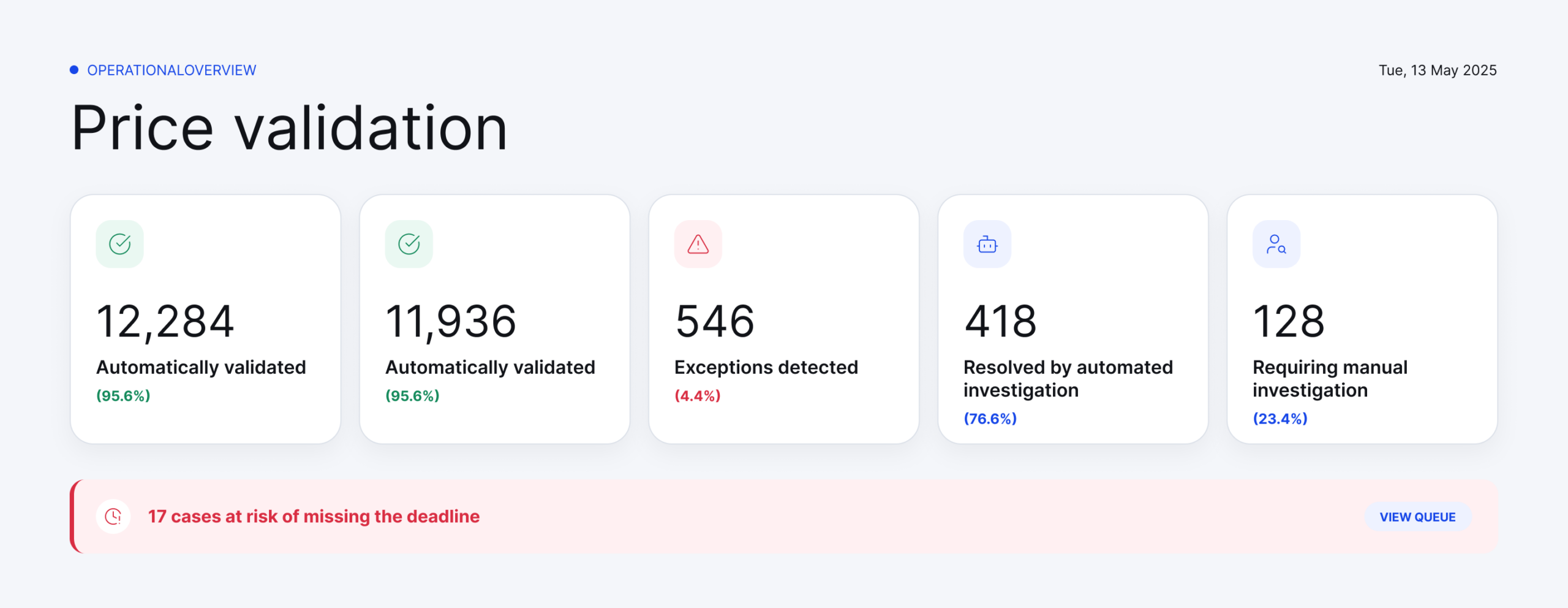
The central design challenge: How do we shift analysts' attention from processing 12,482 prices to making confident decisions on the 128 that require judgment before 6 PM?
Disclaimer
Company policy prevents me from exporting internal design artifacts. This case study is independently reconstructed from my work using fictionalized data and recreated interfaces. Original research materials, client data and proprietary implementation details are not included.
Because the original product artifacts couldn't leave LSEG, I independently reconstructed the experience with fictionalized data. I used an AI-assisted design and coding workflow to turn the service model into a working browser prototype, allowing me to test the interaction model end to end rather than recreate a set of static screens.
My role
Product design, service design, workflow modeling, AI interaction design, prototyping
Collaborators
Product, domain experts, client stakeholders, sales and technology partners
Problem discovery
The problem wasn't detecting exceptions. It was resolving them before the deadline.
Price validation is a high-volume operational process with a hard daily deadline.
Thousands of prices can be evaluated automatically. Exceptions are different. An analyst may need to determine why a price failed validation, find relevant market evidence, compare sources, understand the financial impact, decide whether the price is defensible, and sometimes contact a client or another expert for additional evidence.
And all of that work competes for time before the validation deadline.
I started with the system, not the interface
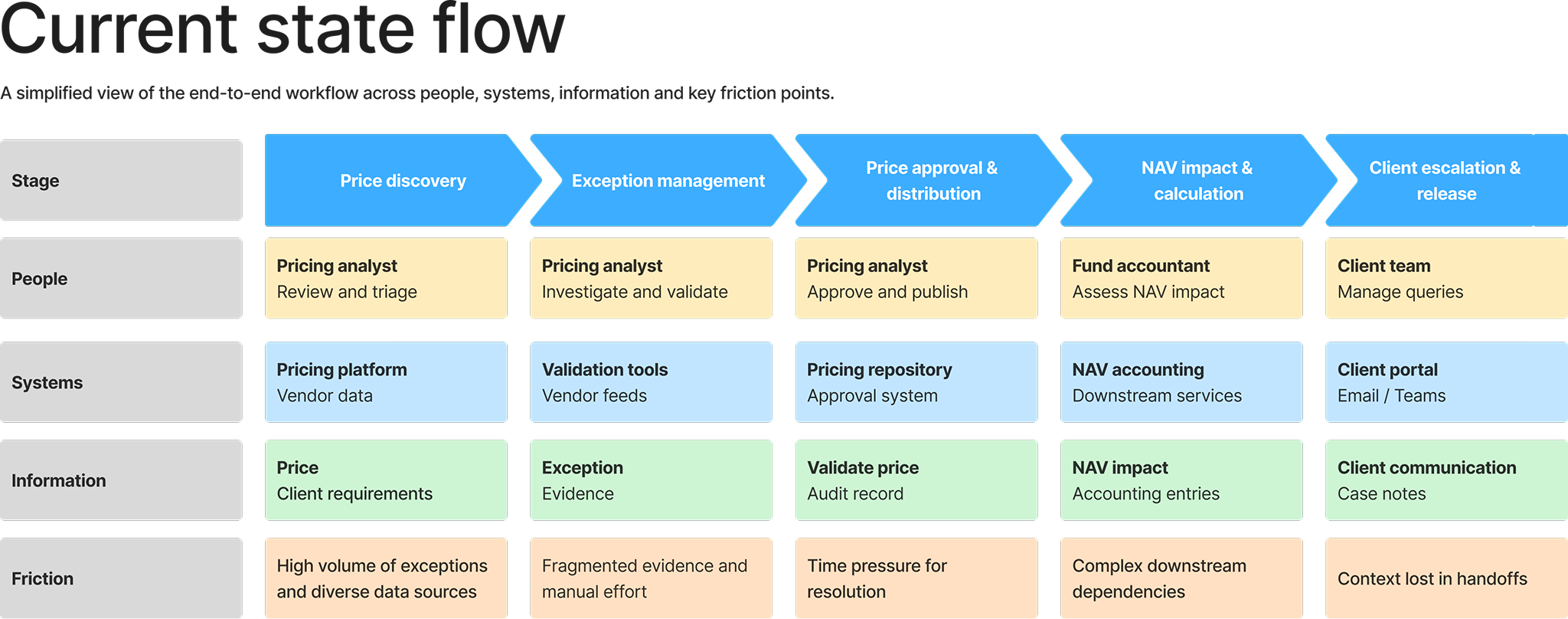
Before exploring an AI experience, I mapped the existing workflow across people, systems and operational stages. The process extended well beyond a single pricing application.
An exception could move between pricing analysts, client teams and fund-accounting functions while drawing evidence from pricing platforms, vendor data, validation tools and downstream accounting systems.
Investigation was the bottleneck
Evidence gathering crossed multiple systems and sources.
Not every exception required the same level of judgment
Some could be resolved deterministically; others depended on materiality, ambiguity or contradictory evidence.
The deadline changed prioritization
Analysts needed to understand not simply what was unresolved, but what posed the greatest operational risk.
Mapping the workflow changed the problem from “How might we help analysts investigate exceptions?” to “Which parts of an investigation require human judgment at all?”
Finding the right boundary between automation and judgment
The existing process contained different classes of work that shouldn't all be treated the same way.
Some prices could be validated deterministically. Some exceptions required additional evidence but could potentially be resolved automatically. Others contained enough ambiguity, materiality or conflicting evidence that an analyst needed to make the decision.
I explored several future-state operating models, including enriched data feeds, batch/API enrichment, an AI research environment, and agent-to-agent investigation.
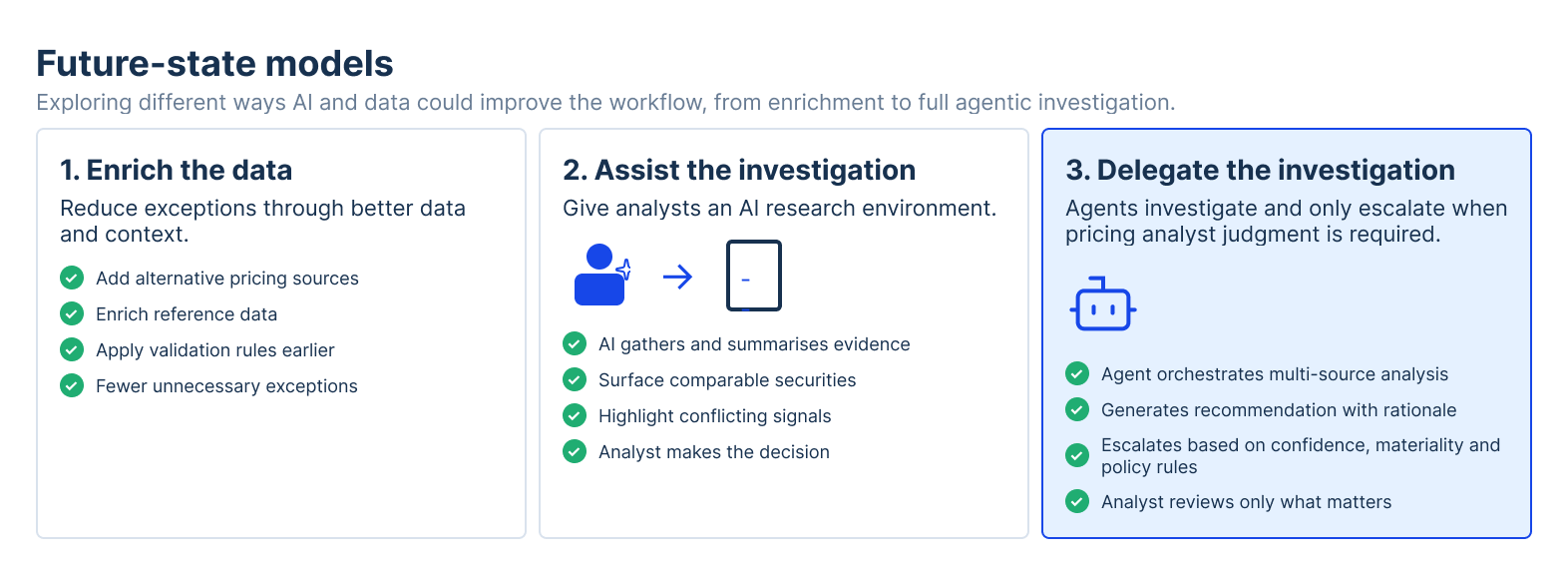
I chose to automate the repeatable investigation work—not the pricing decision.
The strongest model wasn't an AI assistant layered onto the existing workflow. That still required analysts to initiate and interpret every investigation.
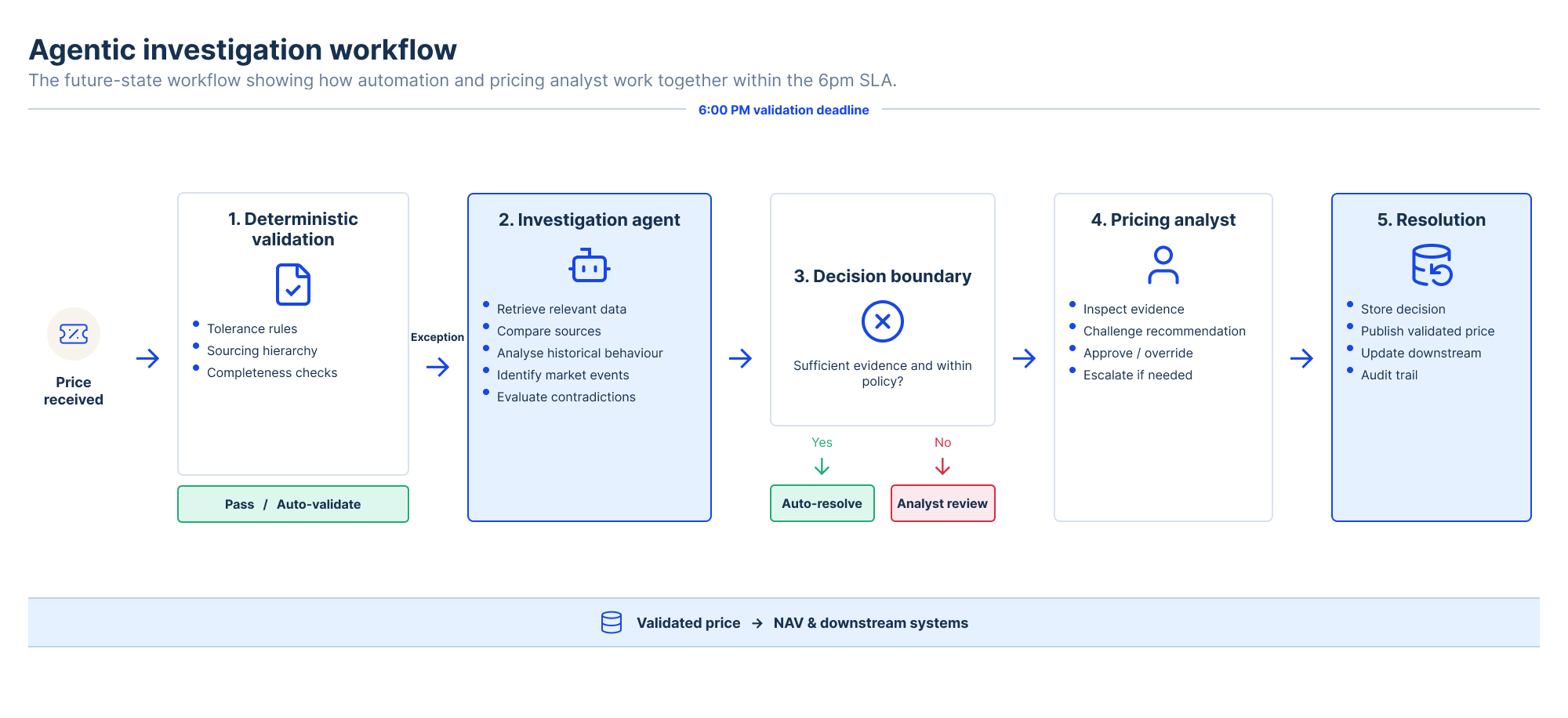
Instead, I proposed that automated services gather evidence, compare sources and surface contradictions before an analyst enters the workflow. Explicit review criteria—such as materiality, conflicting evidence or insufficient confidence—determine when a pricing analyst needs to make the decision.
Automation prepares the investigation. Pricing analysts own the decision.
Redesigning how work moves through the system
From the service model, I defined a future-state workflow in which automation progressively narrows the work requiring human attention.
From service model to working product
I translated the future-state workflow into an interactive prototype to test how automated investigation, analyst review, escalation, and resolution could work as one continuous experience.
The prototype follows a pricing analyst from the operational overview into a prioritized exception, through the supporting evidence and pricing decision, and finally into client communication and resolution.
Designing around analyst attention
The future-state workflow changed what the interface needed to prioritize.
Rather than treating every exception equally, the experience focuses analysts on what requires their judgment—and what threatens the 6 PM deadline.
At a glance, analysts can see validation progress, how much work automation has completed, and which cases need attention.
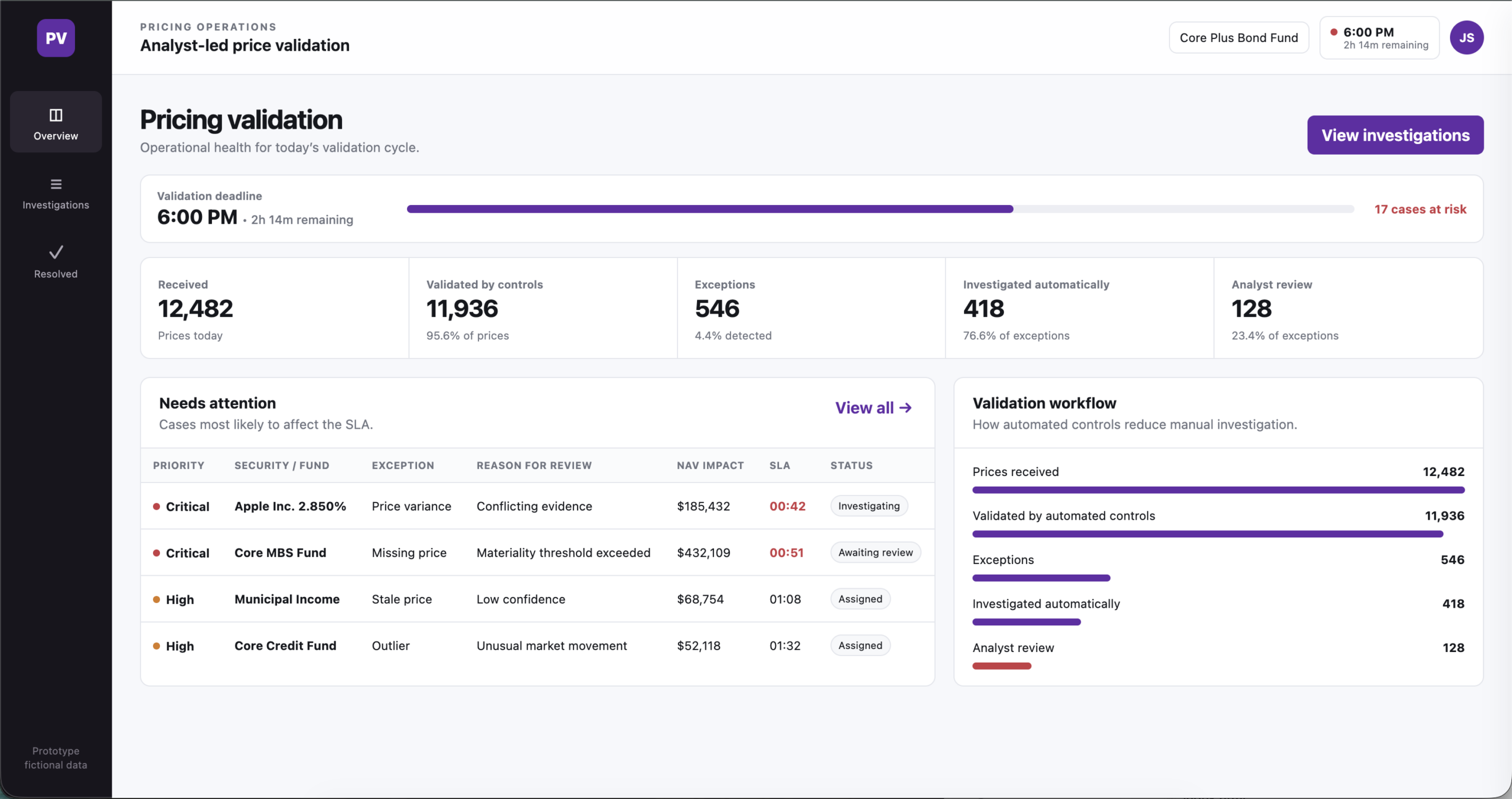
Instead of asking analysts to find what matters, the system focuses on attention to SLAs:
- Are we on track for 6 PM?
- How much has already been validated?
- Which cases require analyst review?
- Why does each case require judgment?
Trust from inspectability
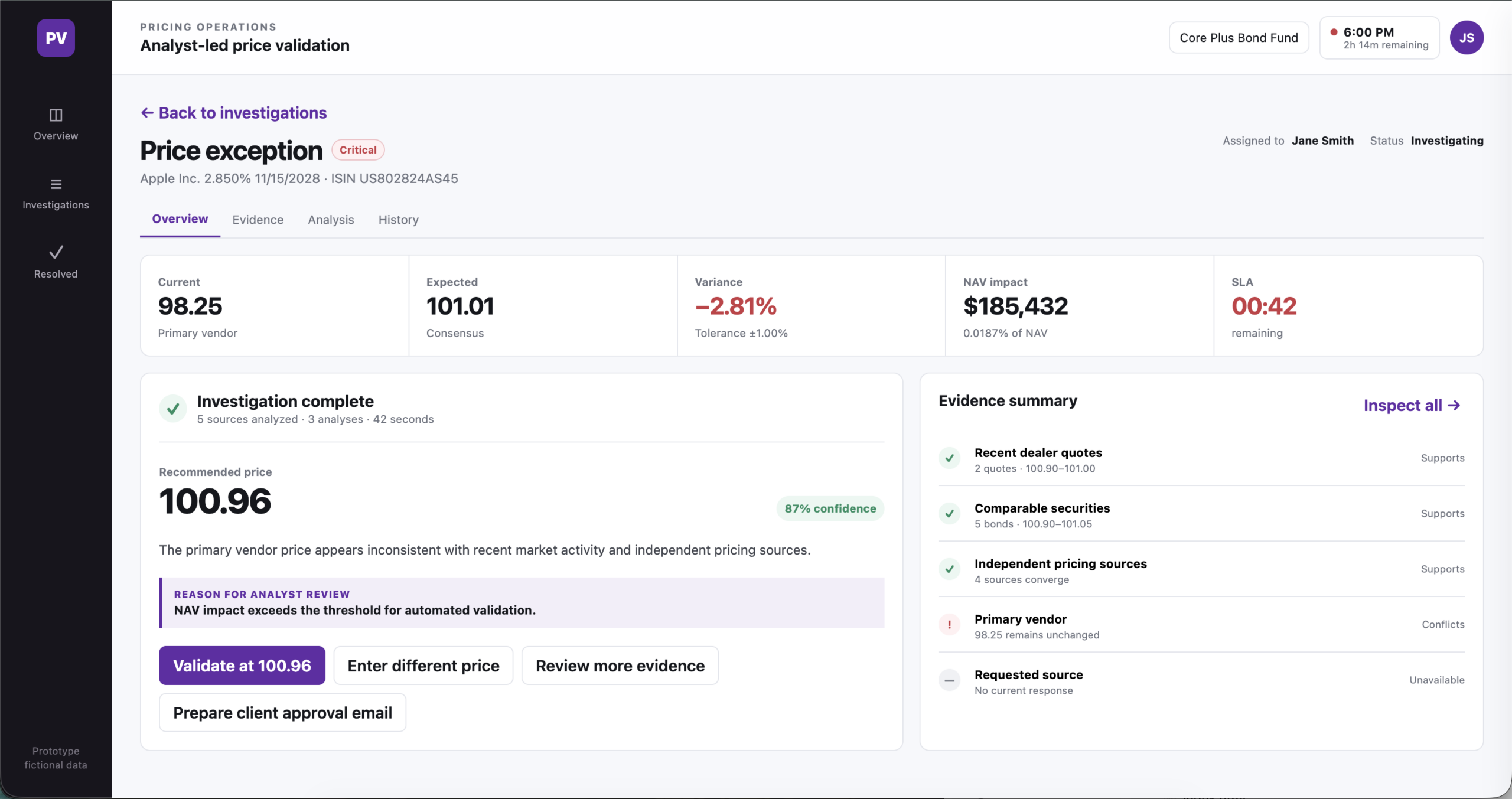
Early concepts focused on the recommendation: a proposed price and an AI confidence score. But analysts needed more than an answer.
They needed to see what the system investigated, which evidence supported or contradicted its recommendation, and why human intervention was necessary.
The design evolved to make the investigation transparent, allowing analysts to evaluate the evidence and make informed decisions.
Keeping context attached to the investigation
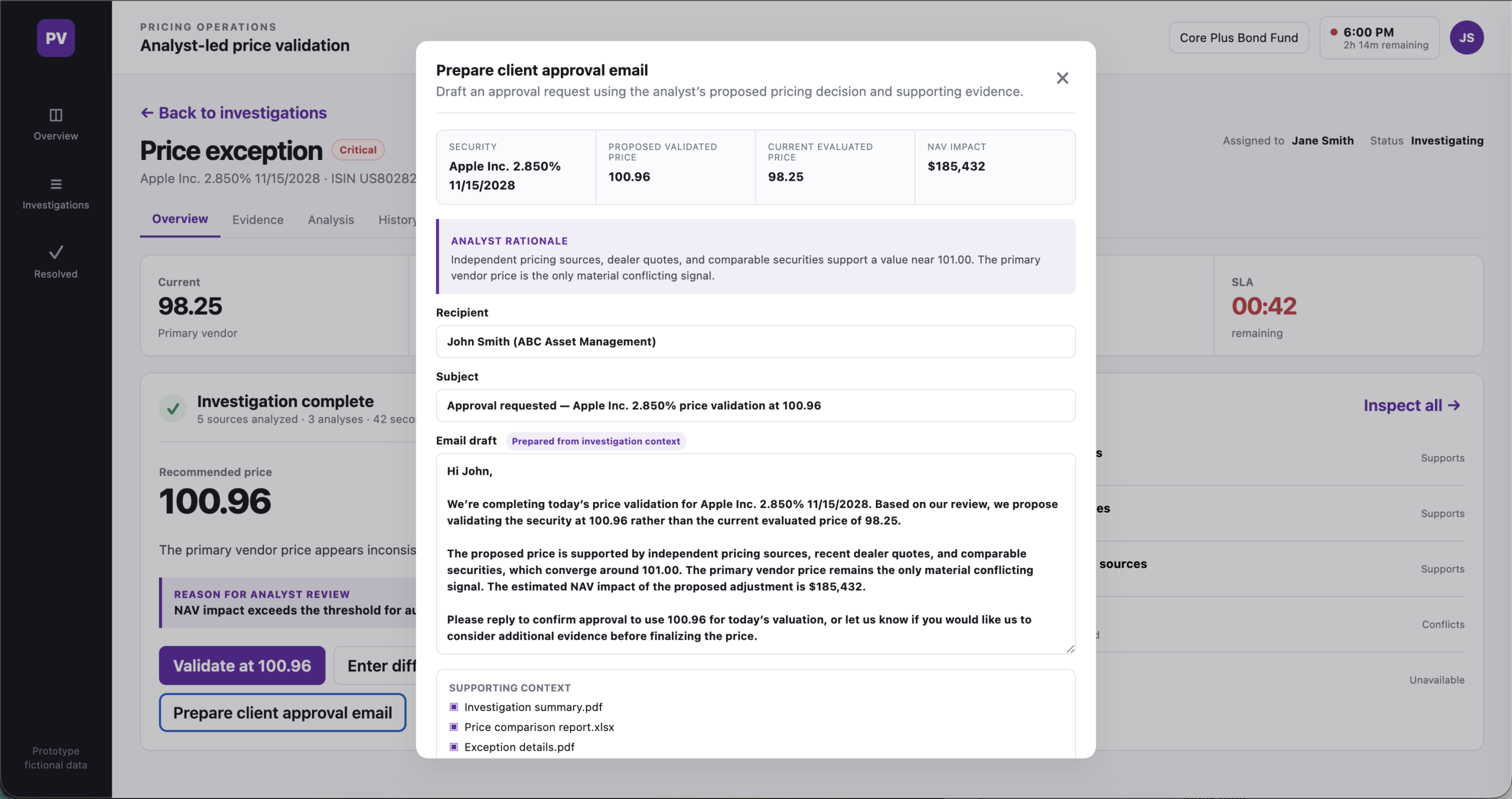
Some pricing decisions require client approval. Moving these conversations into email or Teams can separate the request from the evidence and reasoning behind it.
I designed an escalation flow that brings the proposed price, supporting evidence, and analyst rationale into a draft communication. Analysts can review and edit the message before sending, while keeping the investigation and its supporting context connected.
Outcome
This was exploratory work, not a production launch. The result was a proposed product direction rather than measurable operational improvements.
The work gave LSEG and client stakeholders a shared view of how automated investigation, analyst judgment, and escalation could work together across the validation service.
The service model and interactive prototype made that direction tangible, helping teams evaluate tradeoffs and identify what would need further validation before implementation.
What I learned
AI changes the allocation of work, not just the interface.
The largest opportunity wasn't generating a better recommendation. It was deciding which work the system should perform before an analyst ever became involved.
Analyst review needs an explicit reason.
In an agentic system, “human in the loop” shouldn't mean every result goes to a person for approval. The system should have explicit boundaries for materiality, ambiguity, confidence and conflicting evidence that determine when judgment is required.
Evidence is part of the product.
For expert users making consequential decisions, provenance, contradictions and uncertainty aren't explanatory metadata. They're core interaction design.
Open to hearing about new opportunities
Get in touch via LinkedIn
© SARI HARRIS 2026